The right commercial freezer starts with a written requirement, not a door count. Use this guide to turn stock, access, site constraints and quote exclusions into a purchase you can explain.
The decision in brief
Write a one-page brief, eliminate equipment that fails a must-have, and compare only the candidates that remain. Capacity, a low price or an energy label cannot compensate for the wrong storage duty or an unconfirmed installation.
Your output: a shortlist supported by a stock plan, site questions, matching quote scope and a record of what is still unknown.
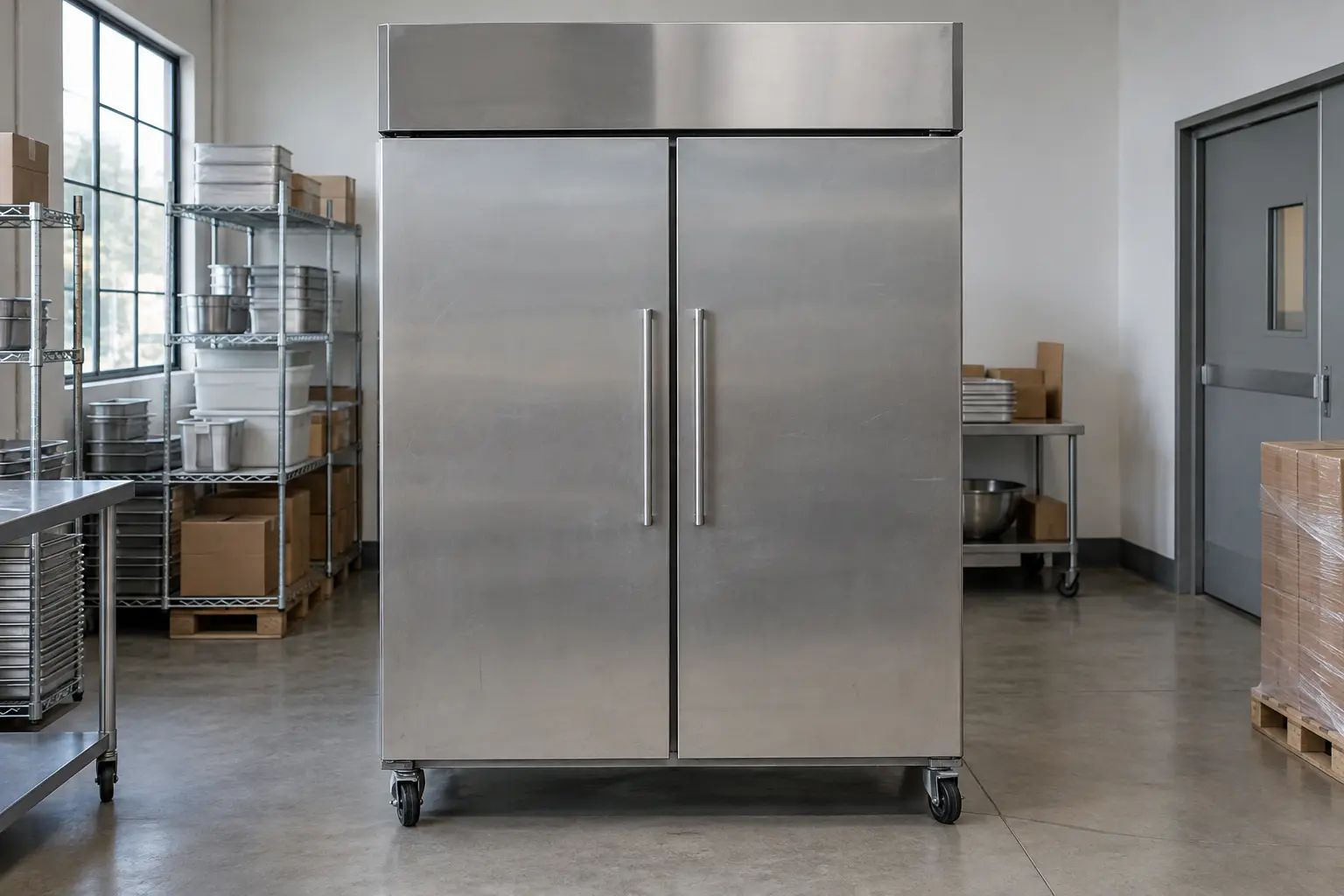
A restaurant replacing its only freezer has a different problem from a grocery store adding a frozen-food display. One needs dependable access to ingredients during service. The other needs shoppers to see, reach and choose a product. A useful commercial freezer buying guide should separate those jobs before it recommends a cabinet.
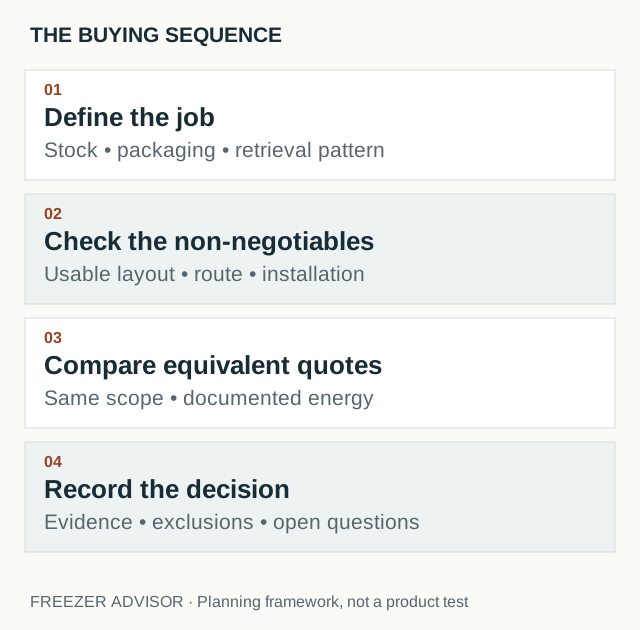
Our approach is simple: write a one-page buying brief, rule out equipment that cannot do the job, and compare the remaining quotes on the same terms. This guide covers self-contained commercial cabinets for small foodservice and grocery operations, not walk-in construction, laboratory storage or blast-freezing system design.
Start with the job, not the door count
Finish this sentence before requesting a price: “We need this freezer to hold _____, in _____ packaging, for _____ people to retrieve or restock.” It sounds basic. It also exposes missing information that a cubic-foot figure cannot answer.
Write down your busiest normal stock position, not just the nearly empty cabinet before the next delivery. Include the awkward items: long cartons, tall containers and trays that do not fit neatly on a standard shelf. If you expect growth, explain what will grow. “One additional delivery each week” is more useful than “some extra capacity.”
Separate frozen storage from the process of freezing incoming product. Do not assume a storage cabinet is suitable for cooling or freezing a particular load. Put that duty in the brief and obtain confirmation for the exact equipment and process.
Choose a format around access
| Your main job | Format to evaluate | Question that decides the shortlist |
|---|---|---|
| Staff retrieve many different ingredients | Upright or reach-in cabinet | Can the actual containers be arranged so each item is easy to identify and retrieve? |
| Reserve stock is retrieved in batches | Commercial chest freezer | Can staff reach and rotate the bottom layer without repeatedly moving other stock? |
| Customers choose packaged frozen products | Commercial display freezer | Does the proposed shelf layout work for shoppers as well as restocking? |
| A small station needs nearby storage | Suitable undercounter or worktop format | Does the model meet the storage duty without obstructing the work area? |
These categories overlap. “Reach-in” describes access, while “glass door” describes a door configuration. A tall cabinet can have either solid or transparent doors. Compare the upright and chest layouts first, then consider display versus solid-door storage.
Size the stock before sizing the cabinet
Create a short inventory with four columns: item, package dimensions, peak quantity and retrieval frequency. Photograph or sketch the proposed shelf arrangement for your own purchasing file. Do not convert total package volume straight into a freezer requirement; shelf positions, baskets, internal equipment and the loading instructions affect what can actually be stored.
For example, consider a hypothetical cafe keeping pastry cartons and several small ingredient containers. The cartons may determine shelf spacing, while the containers determine how often the door opens. Buying on total volume alone misses both constraints.
The Department of Energy recommends matching commercial refrigeration size to its intended use and cautions against oversizing. Its commercial equipment purchasing guidance is a useful starting point, not a capacity formula for your menu.
Check the building before you commit
A cabinet has to fit twice: on the way in and in its operating position. Record the delivery route, the narrowest opening, turns, thresholds and any lift restrictions. At the final position, account for the moving door or lid, ventilation instructions, cleaning access and service access. Our freezer sizing and installation checklist separates those measurements.
Ask a qualified installer to review the exact model’s electrical and installation requirements. A matching-looking plug or a nearby outlet is not a site survey. Keep utilities, any building work and final positioning visible in the quote rather than treating them as details to solve after delivery.
Ask for evidence you can file
Request the full model number, selected options, dated technical documents, applicable certification information, warranty terms and a written description of the delivery service. An equipment family name is not enough when a suffix changes the configuration.
For energy-certified candidates, check the exact model in the ENERGY STAR commercial refrigeration directory. Energy certification answers an energy question; it does not settle every installation, sanitation or local approval question.
The FDA Food Code is a model used by regulatory jurisdictions. Ask your local authority which requirements apply to your operation. Do not treat a national guide, or this article, as approval for a particular site.
Put the quotes on equal terms
Use separate lines for equipment, freight, liftgate or inside delivery if needed, installation, utility work, removal of old equipment and optional service. Mark a missing price “not supplied,” never zero. Ask when the warranty begins and who handles a service request at your address.
Compare electricity separately using documented consumption and your tariff. Our commercial freezer running-cost guide explains the calculation. A lower purchase price and a lower running cost are different advantages; neither should disappear into an unexplained “best value” label.
The buying desk: a brief worth sending
We are buying for: _____. Products and packaging: _____. Peak stock: _____. Access pattern: _____. Proposed location and delivery route: _____. Installation reviewer: _____. Must-have documents: _____. Unresolved questions and owners: _____. Required in-service date: _____.
Send the same brief to everyone quoting. Keep exclusions attached to the price. If one supplier proposes a different format, ask which part of the brief it improves and what trade-off it creates. You should be able to explain the final decision in a paragraph without quoting a sales slogan.
Use an exception log, not an unexplained score
Before scoring price or preferred features, give each must-have one of three states: confirmed, failed or unresolved. Record the supporting document and who checked it. An unresolved item is not a pass, and a cheaper quote cannot offset a failed requirement.
| Requirement | Evidence to retain | Decision rule |
|---|---|---|
| Storage duty and package layout | Exact model documents and permitted stock arrangement | Reject a confirmed mismatch; resolve missing information |
| Delivery and operating position | Measured route, installation requirements and responsible-party response | Do not treat an unconfirmed route as acceptable |
| Quote completeness | Dated itemized offer and written exclusions | Keep missing prices outside the total until supplied |
| Preferred features | The operational benefit and additional price | Compare only after must-haves pass |
Keep the rejected options and their reasons in the same file. If the stock plan, site or model changes later, that record shows which checks need reopening. This is an editorial purchasing method, not a certification or a field-tested performance score.
Questions buyers ask
How many cubic feet does a restaurant need?
There is no useful universal answer based only on restaurant size or seat count. Build the requirement from peak stock, package shape, delivery pattern and usable loading arrangements. Confirm it against the exact cabinet.
Should I buy the largest freezer that fits?
Only if the capacity serves a defined need. Extra volume is not a substitute for an inventory plan, and physical fit alone does not confirm installation suitability.
What should stop me from placing the order?
An unresolved delivery route, unconfirmed installation requirements, unclear equipment duty or a quote with material exclusions you cannot price. Use the pre-purchase checklist to close those gaps first.
Source and method notes
Official references are linked beside the relevant points. The brief, shortlist and cafe scenario are Freezer Advisor planning tools, not field-test results. The photograph-style image is AI-generated and represents no actual site or model. The decision graphic is an editorial framework, not installation instructions.
Record the decision
These fields stay on this page, are not saved or sent, and clear on reload. Print to keep a copy. Do not enter sensitive information.