A useful running-cost estimate has three visible inputs: documented daily consumption, powered days and your electricity rate. The result is an energy budget—not a promise about the utility bill.
The decision in brief
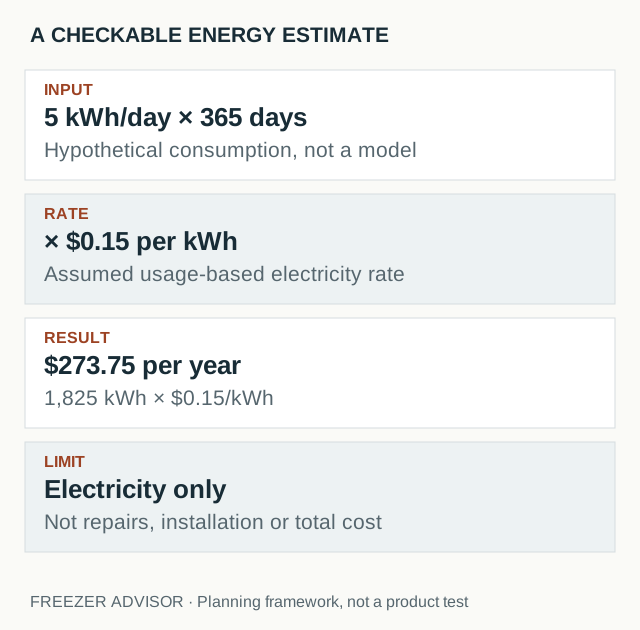
Daily kWh × powered days × price per kWh = estimated electricity cost. For an explicitly hypothetical 5 kWh/day freezer running 365 days at
A freezer’s price tag is visible. Its electricity budget usually is not. You can make a useful first estimate with three inputs, provided you keep their limitations in view.
.15/kWh, that is 3.75 per year.
Replace every example input with your own documented value. Nameplate watts, restaurant opening days and an unexplained national average are not substitutes for those inputs.

“How much will it cost to run?” should not produce a number with no working behind it. For a commercial freezer, ask for documented daily electricity use, the days the equipment will stay powered and the energy rate you intend to use. Those inputs produce an estimate you can check and update.
This guide calculates electricity cost. It does not predict repairs, product losses or the full financial return on buying a freezer. We use clearly hypothetical equipment figures below; they are not measurements of a named model or an industry average.
The running-cost formula
Estimated electricity cost = kWh per day × powered days × price per kWh.
If the freezer remains on all year, use 365 days for a normal year, even if the restaurant serves customers only five days a week. Business opening days and powered days are not the same input. A 30-day month can be useful for a monthly illustration; annual cost divided by 12 gives an average month instead.
The U.S. Energy Information Administration’s explanation of electricity units distinguishes power, measured in watts or kilowatts, from energy used over time, measured in watt-hours or kilowatt-hours. Your consumption input here is energy: kWh.
Find three inputs you can explain
1. Documented daily energy use
Record the exact model, configuration, kWh/day figure, source and date. Check listed equipment in the ENERGY STAR commercial refrigeration directory. If you are given a document rather than a directory entry, keep it in the purchase file and ask what the figure represents.
A standardized test figure is useful for a documented comparison, but it is not a reading from your kitchen. Ask how your loading pattern, environment and equipment use relate to the stated conditions. If you have reliable measured data for an existing unit, label the measurement period and conditions; do not silently compare it with a new unit’s laboratory figure as though the two were identical evidence.
2. Days the freezer stays powered
For a seasonal business, record the actual planned powered period. Do not reduce the estimate merely because the dining room closes on Mondays. Nor should a budgeting worksheet be used as advice to switch off equipment containing stock.
3. Your electricity rate
Read the tariff or ask the utility to confirm the appropriate usage-based rate. A whole bill divided by total kWh can mix fixed charges, demand charges, taxes and energy costs. If you use that blended rate as a rough budgeting input, label it that way; it is not necessarily the cost of one additional kWh.
A worked example: two hypothetical cabinets
Assume both candidates have already passed the same storage and site requirements. For this arithmetic exercise only, Cabinet A uses 5 kWh/day and Cabinet B uses 4 kWh/day. Both remain powered for 365 days, and the assumed energy rate is $0.15/kWh.
| Calculation | Cabinet A | Cabinet B |
|---|---|---|
| Assumed daily consumption | 5 kWh | 4 kWh |
| Annual energy use | 1,825 kWh | 1,460 kWh |
| Annual electricity cost | $273.75 | $219.00 |
| Average monthly electricity cost | $22.81 | $18.25 |
| Electricity cost for exactly 30 days | $22.50 | $18.00 |
The annual difference is $54.75. At $0.30/kWh, keeping every other input unchanged, the annual costs become $547.50 and $438.00, a difference of $109.50. That is a sensitivity check: it shows how the assumption changes the answer, not what your utility will charge next year.
Try your own documented values in the Freezer Advisor energy cost calculator. Keep the chosen inputs beside the result so another person can reproduce it.
Do not buy an energy saving that changes the job
A smaller freezer may report a lower daily figure but fail to hold your stock. A display cabinet and a staff-storage cabinet may not provide the same function. First establish equivalent needs using the commercial freezer buying brief; only then compare the energy estimates.
If you are choosing between door formats, the glass-door and solid-door comparison helps define the task. The lowest kWh/day number is not a useful winner if the equipment cannot perform it.
What if the lower-energy model costs more?
Suppose Cabinet B in our example costs an additional $300. Dividing $300 by the $54.75 annual electricity difference gives a simple electricity-only payback of about 5.5 years. This is our arithmetic using hypothetical inputs, not a forecast or a recommendation to pay that premium.
The calculation ignores financing, changes in electricity prices, maintenance differences, equipment life and the value of money over time. If the documented annual saving is zero, there is no electricity-only payback to calculate. If a saving is uncertain, do not turn it into a precise promise.
DOE’s commercial refrigeration purchasing guidance considers acquisition and energy costs together. Its worked savings table is for a refrigerator under stated assumptions; do not copy those figures into a freezer budget.
Keep these costs outside the energy line
- One-time costs: delivery, positioning, installation, electrical work and disposal of replaced equipment.
- Recurring non-energy costs: agreed service, cleaning labor and any monitoring subscription.
- Tariff items: demand charges, fixed fees and other charges not represented by the chosen kWh rate.
- Uncertain costs: repairs, downtime and stock loss. Record the risk and mitigation plan rather than inventing an annual allowance presented as fact.
This separation makes a quote easier to challenge. “Annual running cost” should not mean electricity in one proposal and a complete service contract in another.
Questions about freezer energy use
Can I multiply the nameplate watts by 24 hours?
That calculation assumes the stated power is drawn continuously. It is not a reliable substitute for documented daily consumption or an appropriate measurement. Keep rated power, circuit requirements and measured energy use separate.
Does an ENERGY STAR label guarantee my bill?
No. The ENERGY STAR program page provides certification context. Your bill also depends on use and tariff conditions; the label is not a site-specific dollar guarantee.
What should I save with the quote?
The full model identifier, data source, daily kWh figure, assumed powered days, rate and date of the calculation. Add unresolved questions. A transparent estimate with one unknown is more useful than an exact-looking figure nobody can explain.
Source and method notes
All numerical cabinet examples in this article are hypothetical. Calculations use the displayed inputs and round currency to two decimal places. Official references support the units and purchasing context, not a claim that Freezer Advisor tested either cabinet.
Record the decision
These fields stay on this page, are not saved or sent, and clear on reload. Print to keep a copy. Do not enter sensitive information.