A glass door buys visibility. Whether that is useful depends on the person opening it, the packages behind it and the job the cabinet must perform.
The decision in brief
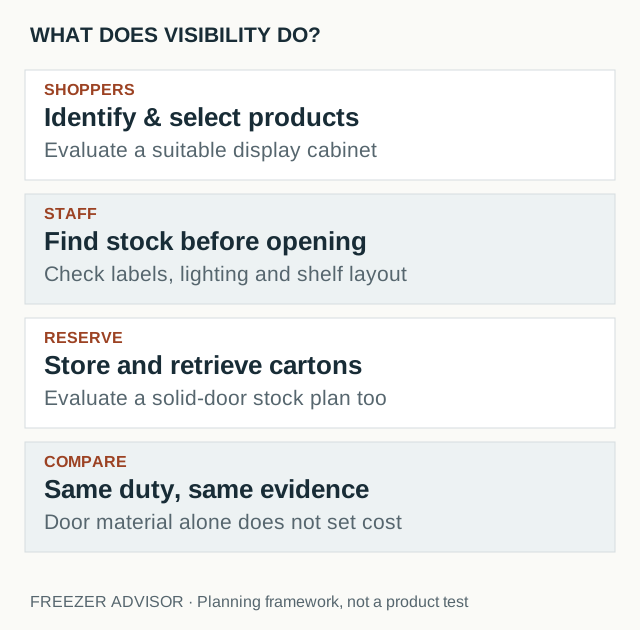
For shoppers selecting packaged products, evaluate suitable display equipment. For staff storage, first establish whether seeing the stock actually improves retrieval; a labeled solid-door stock plan may solve the same problem.
Compare the exact models: door material alone cannot tell you the energy bill, permitted use or installation suitability.
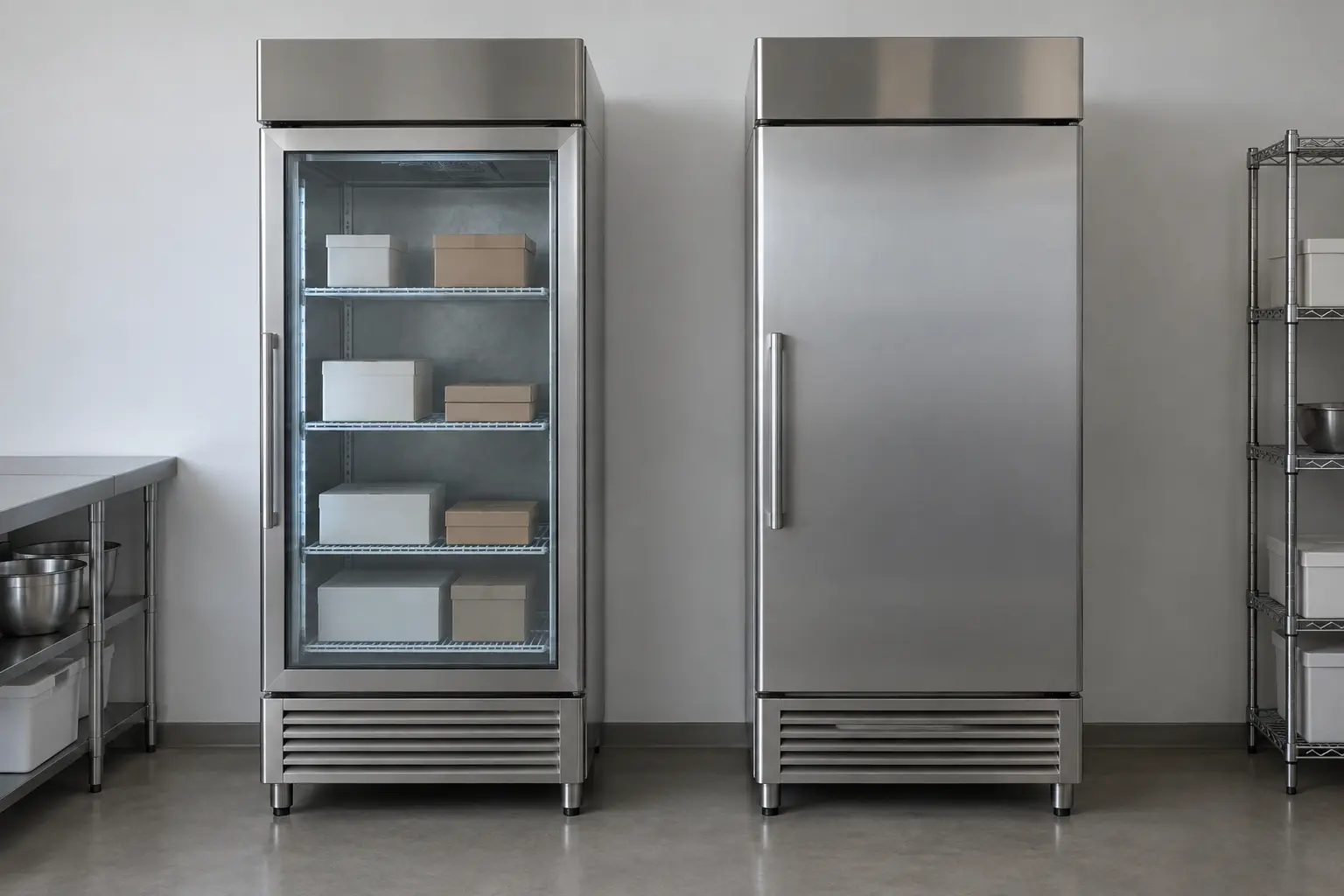
A grocery owner wants customers to choose a product without searching through a backroom cabinet. A kitchen manager wants ingredients available during service. Both may consider a glass-door freezer, but they are buying visibility for different reasons.
The first question is therefore not whether glass looks better than stainless steel. It is what the door needs to help someone do. Start there, then compare the actual storage arrangement, operating conditions and costs.
Decide whether the job is display or storage
For customer-facing frozen-food sales, evaluate equipment specifically suited to the proposed merchandise and setting. Check how the products will be arranged, how shoppers will identify them and how staff will replenish the shelves. A see-through door alone does not confirm that a cabinet is appropriate for your retail plan.
For staff-only storage, ask whether visibility materially improves finding stock or organizing work. If the cabinet mainly holds reserve cartons, the carton fronts may reveal little. A solid-door arrangement with a disciplined stock map may deserve equal consideration.
DOE’s commercial refrigeration purchasing guide describes a trade-off: solid doors provide insulation and cleaning advantages, while glass allows staff to see contents before opening. That is context for a decision, not proof of which particular model will cost less to operate.
Glass door versus solid door: what to compare
| Buying question | Glass-door candidate | Solid-door candidate |
|---|---|---|
| Does the user need to see stock before opening? | Check visibility with the intended products, lighting and shelf arrangement | Check whether location labels and a stock map provide the needed access |
| Is this a customer-facing display? | Confirm the equipment is suited to the actual retail use | Usually a different brief if customers cannot view merchandise before opening |
| Will the real packages fit? | Assess display positions and replenishment access | Assess usable storage positions and retrieval access |
| What is the electricity budget? | Use documented data for that model and configuration | Use the same rate and powered-day assumptions |
| What work does ownership involve? | Document cleaning, checks and service requirements | Document cleaning, checks and service requirements |
Do not treat two cabinets as equivalent because both have two doors. Confirm the storage duty, usable arrangement, site requirements and quote scope. If you are still choosing the basic cabinet format, start with the commercial freezer buying guide.
For a grocery store, draw the shelf plan first
List the products you intend to display, package dimensions, desired facings and expected replenishment quantities. Sketch a shelf arrangement using the actual permitted layout. Keep enough detail to see whether a tall bag, a flat carton and a small tub are competing for incompatible positions.
Try two versions of the plan: freshly restocked and partly sold down. The second is easy to forget. A layout that looks tidy only when every position is full may be awkward to shop or maintain through the day.
Record where price information will sit and whether it obscures the product. Check the view from the shopper’s approach, not only straight in front of an empty cabinet. Include door movement and the nearby circulation space in the site review.
These are merchandising checks, not a promise that a glass door increases sales by a particular percentage. If you later evaluate performance, record your own starting point, product mix and observation period rather than borrowing a generic uplift claim.
For a kitchen, test the stock-finding problem
Imagine a hypothetical kitchen storing identical opaque cartons. If nobody can identify the contents through those cartons, replacing the outer door with glass may not solve the real problem. Clear stock locations and a usable retrieval plan might matter more.
Now imagine staff selecting different labeled containers across several shelves. Seeing the arrangement before opening could be useful, but only if the actual position, lighting and labels support that view. Write down what visibility is expected to improve and check the proposed configuration against that expectation.
Do not confuse a display preference with a storage requirement. A freezer in a staff area does not need to look like a shop fixture to be a good purchase. Equally, a functional reason for visibility should not be dismissed as cosmetic.
Compare energy and care without blanket claims
The ENERGY STAR commercial refrigeration program includes eligible solid- and transparent-door equipment. Check the exact listing and configuration in its official product directory, rather than assuming that one door material determines the certification or energy result.
Use documented kWh/day figures for equipment that meets the same need, then apply the same rate and powered days. Our commercial freezer electricity-cost guide shows the calculation and its limits. Do not apply a published average saving from one product category to another cabinet.
Ask what the selected model requires for routine cleaning, door care and service access. If condensation or visibility is a concern in the proposed environment, make it a pre-purchase question for the installer and equipment provider. This is not a reason to alter heaters, controls or refrigeration components yourself.
Check the site and the approval questions separately
Glass and solid-door models both need a confirmed delivery route and operating position. Use the sizing and installation checklist to record the exact dimensions and professional sign-offs.
For a customer-facing installation, have the appropriate professional review access and circulation. Foodservice suitability also needs its own confirmation. The FDA Food Code is a model reference; local requirements determine what applies at the site. An energy label is not a substitute for those checks.
The buying desk: a one-paragraph decision
We need [display / staff storage]. The user must be able to _____. Our actual packages fit the proposed layout as follows: _____. The site and equipment duty are confirmed by _____. The cost difference buys us _____. The remaining questions are _____.
If the paragraph cannot explain what visibility contributes, keep the solid-door candidate on the shortlist. If customers need to see and select merchandise, treat the display function as part of the requirement, not as an optional finish.
Common questions
Is a glass-door freezer always more expensive to run?
That conclusion cannot be made from door material alone. Compare documented consumption for suitable models and keep the assumptions consistent.
Can a display freezer also hold reserve stock?
Only within its intended use and loading requirements, and only if doing so still meets the display brief. Do not count hidden reserve stock as useful customer-facing shelf space.
Should every grocery freezer have glass doors?
No. Customer display and backroom storage can require different equipment. Define each job before deciding whether one cabinet can reasonably cover both.
Source and method notes
Official sources support the door-configuration, energy-program and food-code context. Shelf-planning exercises and kitchen scenarios are Freezer Advisor editorial tools. No model was physically tested for this guide, and the illustrations depict no named product.
Record the decision
These fields stay on this page, are not saved or sent, and clear on reload. Print to keep a copy. Do not enter sensitive information.