An upright organizes stock from the front. A chest organizes it from above. The useful comparison is what staff must move, reach and identify during a normal shift.
The decision in brief
Evaluate an upright first for frequent retrieval of varied stock; evaluate a chest for organized reserve stock retrieved in batches. These are shortlist rules, not guaranteed outcomes. The exact shelf or basket arrangement must pass the package and access checks.
Do not infer: a fixed energy saving or usable capacity advantage from the cabinet shape alone.
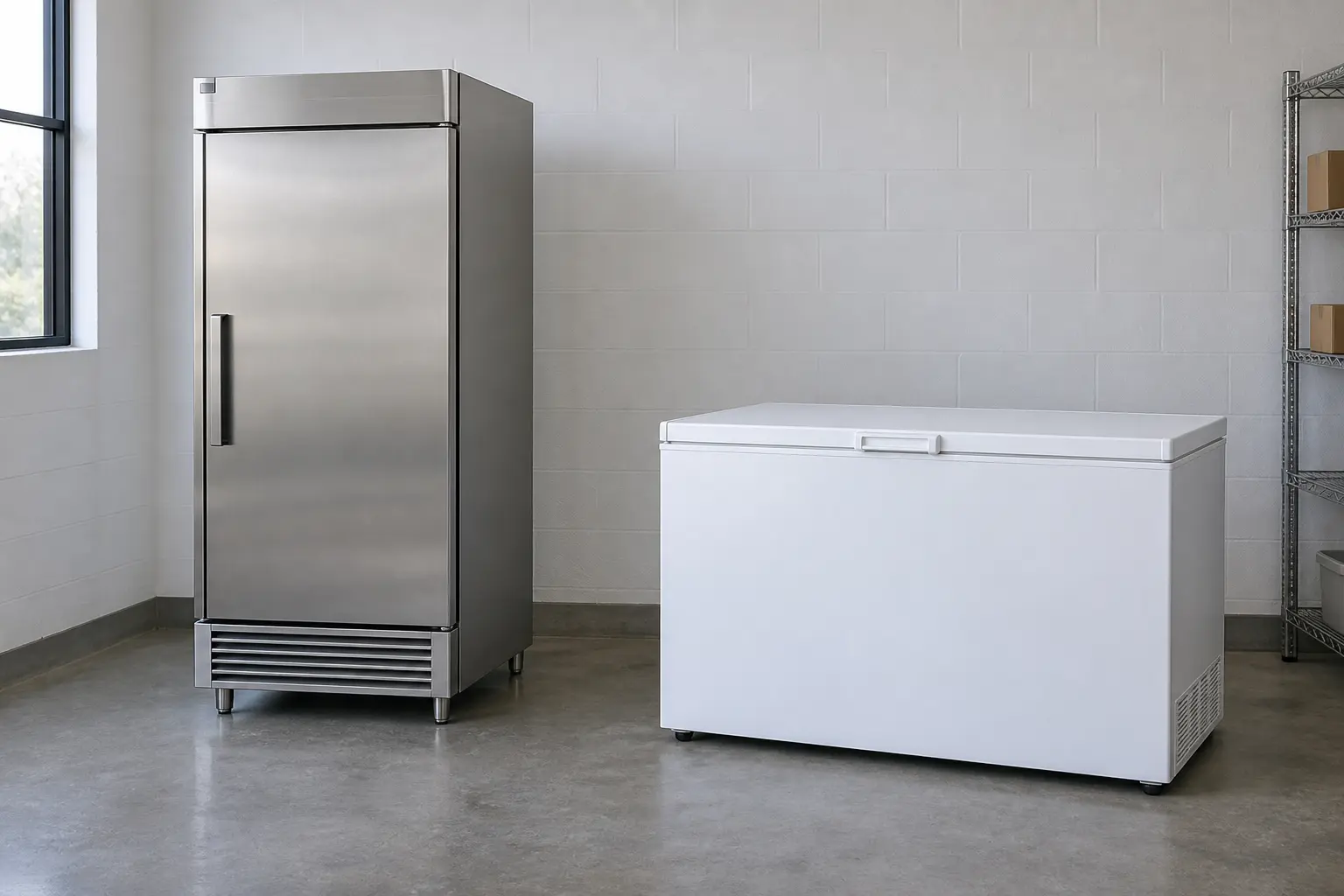
A chest freezer can look spacious until the carton you need is underneath three others. An upright can look organized until your packaging will not fit the shelf arrangement. Neither format solves a poor stock plan. The better choice is the one that makes your particular stock easy to store, find and replenish.
This comparison is for businesses evaluating commercial upright and solid-lid chest freezers. It is not a recommendation to use residential equipment in foodservice, and it does not cover open supermarket islands or walk-in rooms.
Upright versus chest: the practical comparison
| Decision | Upright cabinet | Chest cabinet |
|---|---|---|
| How you retrieve stock | Front access to shelves | Top access to baskets or layers |
| What to mock up | Shelf spacing, container depth and door opening | Basket layout, bottom-layer access and lid opening |
| Space to account for | Cabinet footprint plus working door area | Cabinet footprint plus working lid area |
| Organization question | Can each stock line have a visible, usable position? | Can stock be rotated without losing items below other packages? |
| Energy comparison | Use documented data for the shortlisted model | Use documented data for the shortlisted model |
The table describes access patterns, not guaranteed performance. Internal dimensions, baskets, shelf loading and cabinet geometry vary. A commercial chest freezer is not automatically an equivalent substitute for a reach-in just because the advertised volumes are close.
Start with what happens during service
Write down the items your team retrieves during a busy period. Record whether someone takes one small container, a whole carton or several different ingredients. Then mark which items must be reachable without moving another item first.
An upright deserves a close look when different products need separate visible positions and staff retrieve them repeatedly. That is a shortlist rule, not a promise that any upright will work. Bring the actual package dimensions into the shelf plan.
A chest deserves a close look when reserve stock can be organized into predictable groups and retrieved in batches. Test the awkward part: what happens when the remaining product is at the bottom? If the answer involves repeatedly unloading a basket or lifting a heavy package from a difficult position, revisit the arrangement with your workplace safety reviewer.
Three buying scenarios
A cafe with a mixed pastry and ingredient list
In this hypothetical cafe, several people collect small amounts of different products throughout the day. We would evaluate an upright first, using a shelf map that gives each line a position. The deciding test is not the photograph of the empty cabinet. It is whether the cafe’s actual cartons and containers fit that map.
A bakery keeping reserve cartons
Imagine a bakery retrieving a few consistent carton types at planned times. A chest may deserve a place on the shortlist if the cartons, baskets and staff access work together. If retrieval means digging through mixed stock, the apparent storage advantage may not translate into a useful working arrangement.
A small grocery store adding frozen products
First ask whether the unit is for backroom stock or customer selection. A reserve-stock chest and a customer-facing display solve different problems. If shoppers need to choose from the cabinet, use our glass-door versus solid-door guide rather than treating this as a two-format storage decision.
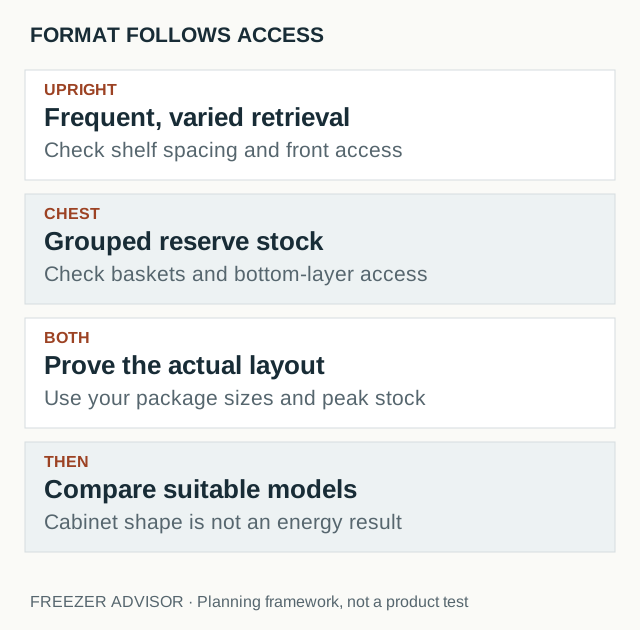
Compare usable arrangements, not matching volume labels
Make a list of package dimensions and planned quantities for each stock line. Ask for the usable internal layout, included shelves or baskets and loading instructions. Draw the proposed arrangement. Count what fits in the permitted positions, not what could theoretically be packed into an empty box.
Keep a separate “retrieval” note beside the capacity count. If a package fits but cannot be removed without rearranging the cabinet, that matters. So does the time needed to identify older stock. You do not need invented labor savings to make the comparison useful; record the movements the arrangement requires.
For the room itself, compare two marked-out footprints and the moving door or lid. Include the delivery route. Use the measurement checklist and the exact installation documents rather than a universal clearance allowance.
Which type uses less electricity?
Do not attach a fixed savings percentage to the cabinet shape. Compare equipment that can perform the same storage job, then obtain daily energy-use figures with their source and test basis. If the data is missing or the models are not comparable, leave the answer open.
The DOE residential freezer guidance explicitly excludes commercial freezers from its scope. A household chest-versus-upright example is therefore not a model-specific commercial energy estimate.
Use the ENERGY STAR commercial equipment directory to check listed candidates, and our running-cost worksheet to price documented kWh figures at the same electricity rate. Absence from that directory alone does not explain whether a product is ineligible, uncertified or listed under another identifier; investigate before drawing conclusions.
The buying desk: make the decision visible
For each shortlisted model, answer five questions:
- Can our peak stock fit in a permitted, usable arrangement?
- Can the team retrieve the most-used items without avoidable rearranging?
- Can we bring the cabinet in and operate it in the proposed position?
- Have the equipment duty, site requirements and service arrangements been confirmed?
- Are the price and energy comparisons based on equivalent scope?
Reject a failed must-have before scoring nice-to-have features. A good-looking scorecard should not rescue equipment that cannot fit the stock or the site. If both formats pass, record which practical advantage you are paying for.
Common questions
Is an upright the same thing as a reach-in?
The terms often overlap in purchasing conversations. “Upright” describes the tall format; “reach-in” describes access. Specify the actual configuration, door type and storage duty rather than relying on the label alone.
Can a chest lid become extra counter space?
Do not budget on that assumption. It is an opening lid, and anything placed there must be dealt with before access. Use equipment only as permitted by its instructions.
What if neither arrangement works?
Return to the buying brief. Separate daily-access stock from reserve stock, reconsider the delivery pattern or seek a different equipment format. More volume is only one possible answer.
Source and method notes
Official energy references are linked above. The comparison table and business scenarios are editorial planning examples, not measured trials or recommendations for a specific model.
Record the decision
These fields stay on this page, are not saved or sent, and clear on reload. Print to keep a copy. Do not enter sensitive information.